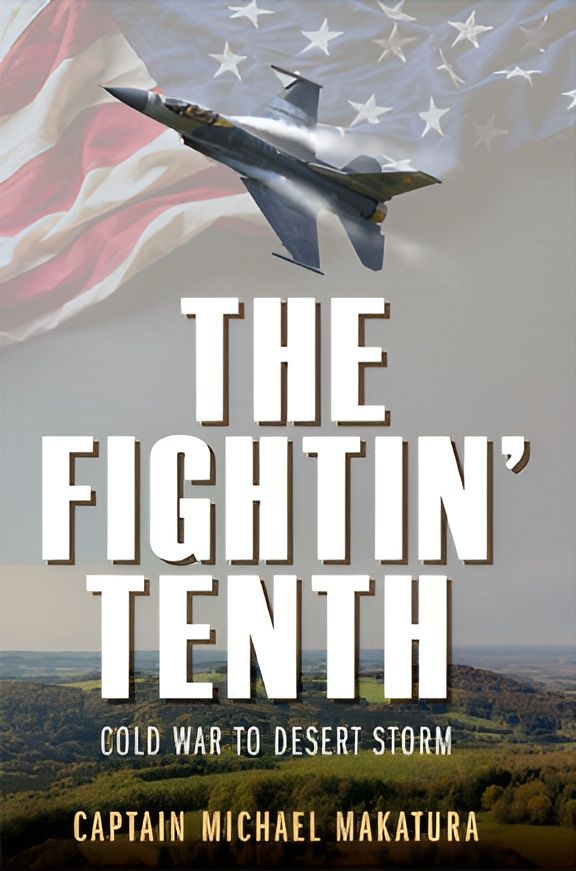
The Fightin’ Tenth Chronicles Elite Fighter Squadron Life From Cold War Tensions To Desert Storm Combat
The Fightin’ Tenth: Cold War to Desert Storm by Capt Michael Makatura
Published 3:46 PM EDT, April 14, 2026
Capt. Michael Makatura delivers a vivid firsthand account of military aviation, leadership, and brotherhood within one of NATO’s respected fighter squadrons.
NEW YORK CITY, NY, UNITED STATES, April 14, 2026 / EINPresswire.com / --
In The Fightin’ Tenth: Cold War to Desert Storm, former U.S. Air Force officer Capt. Michael Makatura offers a gripping and authentic memoir that captures the intensity, discipline, and camaraderie of life inside one of NATO’s premier tactical fighter squadrons.
Spanning the final years of the Cold War through the high-stakes operations of Desert Storm, the book provides readers with a rare, behind-the-scenes look at a defining era in modern military history.
Makatura brings readers directly into the world of the 10th Tactical Fighter Squadron, where pilots trained relentlessly for missions that could be launched at a moment’s notice. From his early days enduring the mental and physical demands of Officer Training School to his arrival in West Germany as a young second lieutenant, the narrative traces his evolution within a culture built on precision, resilience, and unwavering commitment.
The book vividly portrays the experience of flying the iconic F-16 Viper, highlighting both the technical mastery required and the emotional weight carried by those entrusted with such responsibility. As global tensions shift and conflict emerges in the Middle East, Makatura captures the transition from preparation to real-world combat, offering insight into the mindset of pilots operating under pressure, where every decision matters.
Beyond its historical significance, The Fightin’ Tenth is a story of personal growth and shared purpose. Makatura reflects on the bonds formed among squadron members, emphasizing the sense of brotherhood that defines military life. His storytelling balances grit and humor with moments of introspection, creating a narrative that is both engaging and deeply human.
The inspiration behind the book stems from Makatura’s desire to preserve and share the lived experiences of those who served during a pivotal moment in history. By documenting the culture, challenges, and triumphs of the squadron, he provides readers with a meaningful perspective on the realities of military service.
This memoir will resonate with veterans, aviation enthusiasts, and readers interested in Cold War history and modern warfare. It offers a compelling combination of technical detail, personal narrative, and historical context, making it accessible to both military and civilian audiences.
Capt. Michael Makatura draws on his service as a U.S. Air Force officer to deliver a credible and compelling account of life in the skies and on the ground. His voice reflects both authority and authenticity, bringing depth and clarity to a remarkable period in history.
The book is now available—secure your copy here: https://a.co/d/09qfNueB
For review copies, interview requests, or additional information, please contact: Capt. Michael Makatura makaturaorlando@gmail.com
There are men who tell war stories like trophies.
And there are men who tell them like a legacy.
Mak Makatura is the second kind.
Before he ever mentions jets, Desert Storm, or the Fightin’ Tenth, he makes something clear—like he’s making a promise:
“This story is not about me. It’s about us. I just happened to write it down.”
Because Mak isn’t trying to build a monument to his own service. He’s trying to preserve a disappearing kind of American thread—one stitched together by shared mission, imperfect virtue, and ordinary people rising when duty calls.
And when I asked him what message he’d want to leave the world with, he didn’t offer a slogan. He offered a warning—and a hope.
“There are forces trying to drive us apart and break America… but we cannot be broken if we don’t let ourselves be.”
Then he said it plainly:
We are the United States of America. And we are worth saving.
The American Experiment: imperfect, unfinished, and still exceptional
Mak calls America a grand experiment—not because he’s blind to its flaws, but because he believes its ideals are still rare in human history.
In his words, the radical idea wasn’t that our nation would be powerful.
It was that our nation would be built on self-determination—that human beings are endowed with rights that no monarch, dictator, or system gets to revoke.
He doesn’t argue that we haven’t always lived up to our potential greatness. He argues that it is the hope for it—the belief that we can—that compels us, as a country, to rise toward it.
We can strive toward it.
We can sharpen it.
We can keep refining what we claim to be.
“Are we perfect? No. We’ve never been perfect. But we can always strive to fix our imperfections and live more fully in the American ideals.”
For Mak, patriotism isn’t denial.
It’s responsibility.
And that responsibility, he believes, depends on one thing many Americans are losing:
perspective.
The Perspective Problem: when you never leave the bubble, you forget what you have
Mak doesn’t frame today’s divide as a mystery. He frames it as something predictable:
When you never travel, never see the world beyond your orbit, it becomes easy to take freedom for granted. It’s easy to forget why America was different in the first place. Easy to let cynicism replace context.
“I think Americans have lost perspective of who we are and why we’re exceptional.”
And interestingly, his antidote isn’t outrage.
It’s exposure.
It’s getting outside the bubble long enough to see what’s worth protecting—then coming home with the humility to improve it.
Which brings us to the place Mak says changed the entire trajectory of his life.
A fighter squadron in Germany.
Excellence as a way of life: the Fightin’ Tenth and the standard that keeps you alive
Mak grew up working-class outside Pittsburgh—dad a butcher, mom a secretary, grandparents in steel mills and on the railroad. He went to college as the first in his family to do it, knowing education could change the arc of his life.
Then he drove by a recruiting office and felt something deeper than opportunity:
a calling.
He joined the Air Force, completed Officer Training School, and within a year found himself at Hahn Air Base in Germany, assigned to the 10th Tactical Fighter Squadron.
And when he arrived, it felt surreal.
Germany. An F-16 squadron. Central Europe. Cold War stakes.
“If you were mediocre, there was a chance you were gonna die. Hell, if you were excellent, there was a chance you were gonna die.”
The F-16 is a single-seat, single-engine fighter. No one in the back. No margin for drift. That environment produces confidence—sometimes bravado—but mostly it produces something more important:
excellence as a shared language.
And it wasn’t just the pilots. Mak spoke with real admiration for the spouses and families—people who carried the unseen weight so the mission could be carried out.
That pressure, that sacrifice, that danger—shared daily—creates something rare.
A tribe.
The Tribe: why military bonds outlast time, distance, and decades
Mak told me that when he asked people what made the Fightin’ Tenth special, the answer came back again and again:
leadership.
Not just talented pilots, but high-character people who held the standard, protected their people, and led by example.
But the bond wasn’t only built in the air.
It was built in the thousand small moments that make a unit feel like family.
He shared a story about the “LPA”—the Lieutenant’s Protection Association—a playful coalition of the lowest-ranking officers who looked out for each other when the world above them applied pressure.
When someone messed with one of their intel officers, the LPA responded the way young lieutenants do: flight suits on, chests out, straight to the confrontation—equal parts ridiculous and loyal.
And later, when it was “over,” they made sure it wasn’t over.
A bucket of ice water dumped onto the offender’s bed while he slept.
Funny. Harmless. Absolutely human.
But it carries something deeper:
“Even to this day… she knows we’ve got her back, no matter what.”
Then Mak said something that feels like the true definition of family:
“Any one of my brothers could call me right now and say, ‘I need you tomorrow.’ And I would drop everything.”
That’s more than nostalgia.
That’s covenant.
“We pivoted seamlessly”: from Cold War posture to Desert Storm reality
Mak’s squadron trained for a nightmare scenario: Fighting the Soviets in Europe—high risk, potentially nuclear stakes.
Then the Eastern Bloc began to fall. Germany reunified. People joked that “peace is breaking out all over.”
And then Saddam invaded Kuwait.
Suddenly the mission changed. The enemy changed. The terrain changed.
Mak saw it as a testament to training and leadership, yes—but also to trust.
When the pivot comes, you don’t rise to the moment alone.
You rise because you believe the people around you will too.
Ordinary Heroes: “They trusted me with nuclear weapons at 28”
“They trusted me with nuclear weapons when I was 28… what were they thinking?”
He has children that age now. The hindsight hits differently.
But what he took from that isn’t fear.
It’s awe at human capacity.
Mak’s central theme isn’t that heroes are rare.
It’s that heroism is available.
“Heroes are just ordinary people who do extraordinary things when duty calls.”
And then he expands it beyond uniform and war:
You may not change the world a million people at a time.
But you can change one person today.
And that accumulated impact—day after day—does change the world.
The Story that Proves It: 8 Green Berets, one bomb, and three generations of families
Eight Green Berets had been inserted under cover of darkness onto a remote stretch of desert—a thin, exposed ribbon of road running south from Baghdad into Kuwait. Their job was simple in theory. Watch. Report. Disappear.
Then came the moment no amount of training prepares you for.
Three children crested the low ridge just beyond their position—small figures against the vast, empty desert. Barely more than silhouettes at first. Curious. Unafraid. Too young to understand what they had just found.
Eight Green Berets froze beneath the sand and camouflage netting, every instinct sharpened to a single, terrible realization:
They had been seen.
In that instant, the mission tested something deeper than war. Their humanity.
What do you do with children who have just discovered your position behind enemy lines?
Let them go—and risk everything.
Or do the unthinkable, for the sake of the mission and the men beside you?
The decision was made with little discussion.
They let them go.
Through broken English and gentle gestures, they urged them away. Silent pleas carried in hand signals and eye contact. Go home. Say nothing. Please.
The children nodded. Then turned. Then ran.
And within minutes, the desert began to move.
By afternoon, roughly 150 Iraqi Republican Guard troops were closing in.
The Americans dug deeper into the earth, pressing their bodies into the desert, becoming smaller targets. Smaller shapes. Smaller breaths.
Above them, the sky offered no comfort. Just an endless, pale ceiling streaked with black—the oil wells already burning, sending columns of smoke into the atmosphere like open wounds.
They called for air support.
At first, nothing was decisive. Aircraft rotated in and out. Fast movers screaming overhead, searching, circling, trying to see through heat shimmer, smoke, and sand that flattened the entire world into one endless, featureless expanse.
From 18,000 feet, everything looked the same.
Just tan and shadow.
Then MUTT flight from the Fightin’ tenth arrived.
Cutting across the sky at altitude, the cockpits filled with the last slivers of daylight. The sun was falling behind them now, low and blinding, turning the desert into glare and silhouette. Smoke drifted across their line of sight, thick and black, distorting depth and distance.
Below, the Green Berets could hear the vehicles closing in. Engines. Shouting. Metal grinding against sand.
Their radio transmission broke through the static, tight and controlled, but carrying something underneath it. Urgency. Finality.
“Put it right on us. We’re about to get overrun.”
In the cockpit, there was no pause. No time for reflection. Only procedure.
The lead pilot rolled into position. Calculations made in seconds. Wind. Speed. Angle. Guesswork layered on training layered on instinct.
The bomb fell, disappearing almost immediately into the haze.
A moment passed. Then the voice from the ground came back.
“Close! Close! Adjust east!”
Fuel was already becoming a problem. The warning indicators creeping closer to critical.
The second pilot rolled in.
Below him, the desert blurred into abstraction—no clear lines, no clean reference points. Just movement. Smoke. Light. Memory of where the first impact had landed.
He made the adjustment.
Pressed the release.
And waited.
Seconds stretched.
Then the radio erupted.
“Yes—YES. That was the one.”
The Republican Guard advance broke. Momentum collapsed. The pressure lifted.
Eight men, who moments earlier had been facing annihilation, were still alive.
Above them, MUTT flight turned for home. Fuel margins were razor thin now. The aircraft slipped westward into darkness, leaving behind the battlefield, the smoke, and the eight lives they would never see.
Back at base, there was no immediate clarity. Only fragments. Debrief. Questions, and uncertainty.
Then confirmation arrived.
They got them out.
All eight.
Later, Mak told the pilot he was a hero.
The pilot refused the word.
To him, he was just doing his job.
But Mak understood something the pilot couldn’t fully see from inside the moment.
The bomb hit.
Eight men lived.
Those eight men went home. They built lives. They had children. And those children grew up under the protection of a moment they would never remember—but would live inside forever.
“There are eight American families—three generations—living the American dream,” Mak said, “because you did your job when duty called.”
That is what impact looks like.
Not spectacle.
Not recognition.
Just a decision, made under pressure, in fading light— and a ripple that carries further than anyone present could have possibly known.
An America worth saving: the refusal to let the light go out
When I asked Mak for his final message, he didn’t pretend the world isn’t heavy. He acknowledged it.
Then he drew a line in the sand:
There are forces trying to break us.
But they can’t—unless we cooperate.
He called America a shining light on a hill.
Not because it has never flickered.
But because it matters that it stays lit.
“We have to stubbornly cling to the ideals this experiment was built upon… and not allow that light to be extinguished.”
And then he gave the line that would define his entire interview:
We are the United States of America. And we are worth saving.
These are the stories preserved in the pages of his book. Not as relics of a distant war, but as reminders of what ordinary people are capable of when they choose service over self.
The stories of small but consistent impact. Of men and women who did not set out to be heroes, but became something more enduring by simply refusing to abandon the mission—or each other.
Preserving the Fightin’ Tenth
When Mak talks about why he wrote it, he doesn’t start with the missions or the aircraft. He starts with the people. The men and women who stood beside him in briefing rooms and bars, in quiet moments and high-pressure ones. The leaders who set the standard. The spouses who carried the invisible weight at home so others could carry the visible burden in the air.
Those moments weren’t permanent.
Memory fades. People age. Stories soften around the edges. And eventually, if no one writes them down, even the most extraordinary chapters of ordinary lives disappear.
So he began reaching back out. Calling old squadron mates. Asking questions. Filling in gaps. Not to document—but to preserve.
“The book’s really for about 100 people,” he told me. “The men and women of the Fightin’ Tenth.”
Because while the names belong to the Fightin’ Tenth, the truth they represent belongs to all of us.
It belongs to every American who has ever stepped forward when something greater than themselves needed protecting. Every person who chose responsibility over comfort. Every quiet act of courage that never made headlines but changed lives anyway.
The book, on its surface, is about fighter squadrons during Desert Storm and the end of the Cold War.
But its deeper message is simpler than that.
It’s about what happens when ordinary people decide to live like their choices matter.
And what happens when those choices—stacked across time, across generations—become the foundation of something bigger than any single life.
Something fragile.
Something enduring.
Something still unfolding, shaped by the choices of those willing to carry it forward.
An America worth saving.
Mak’s book is being published by Koehler Publishing, and available for preorder on Amazon.com NOW!