Excerpt from Chapter 1:
Clear to Engage
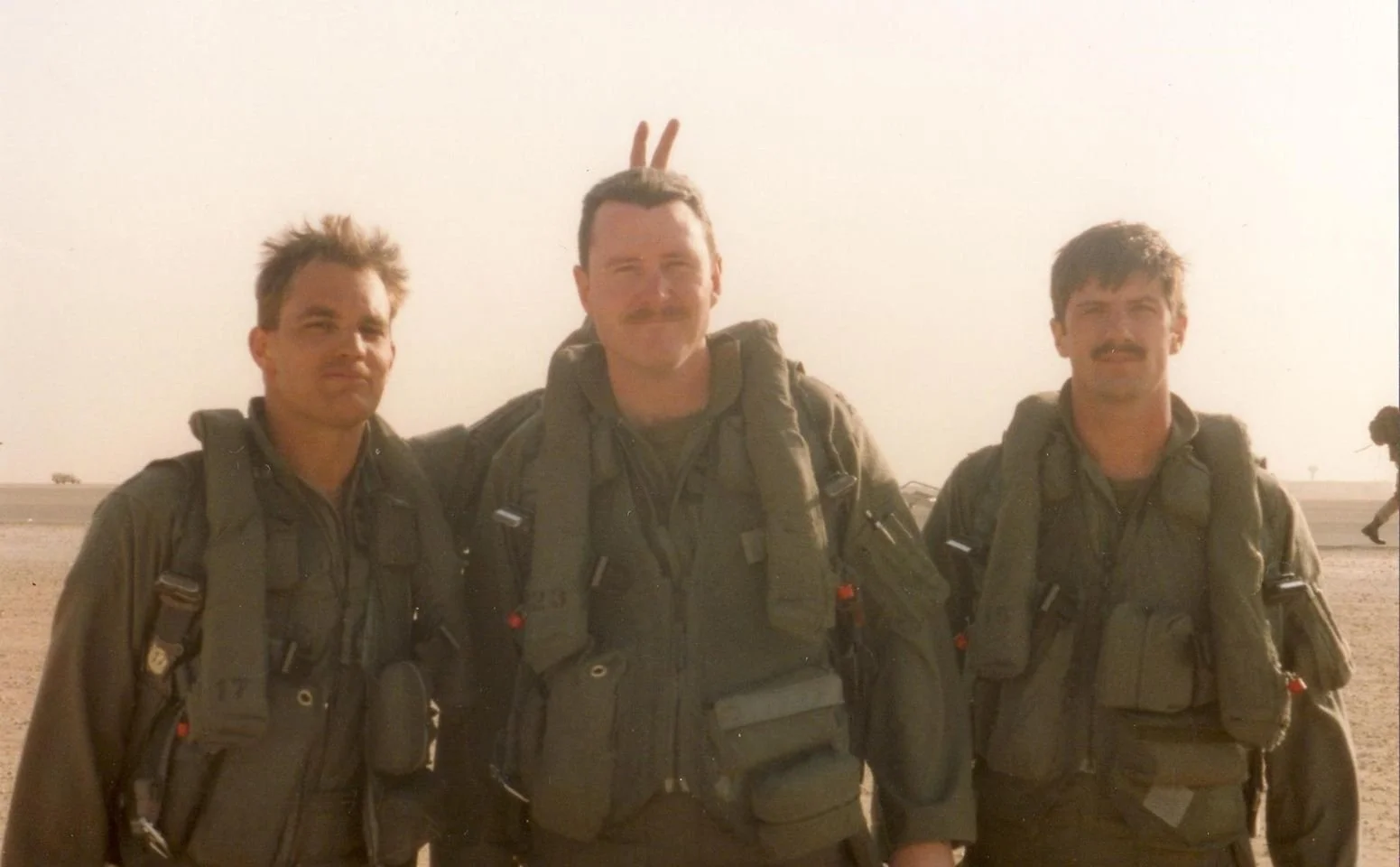
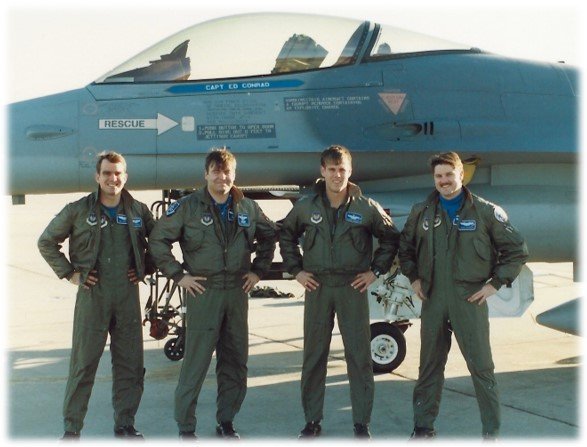
On September 22, 1990, Brahma Flight, a flight of four F-16s from the 10th Tactical Fighter Squadron (TFS), launched from Hahn Air Base, Germany on a simulated bombing mission aimed at a “target” south of Stuttgart. KC Schow was flight lead for the four-ship, with Ed “Julio” Houle, Dave “McGoo” Sandlin, and JD Williams flying as his wingmen. Julio, the 10th TFS squadron commander, was giving KC his initial flight instructor check ride. I was strapped into the back seat of Julio’s jet, riding along for the mission.
We held short at the end of Hahn’s runway, engines rumbling, waiting for takeoff clearance. Once we got the go-ahead, KC & Julio lit the burners, and we rocketed off the runway into the hazy German sky followed 20 seconds later by McGoo and JD. It didn’t take long for things to get interesting.
“Brahma Flight, Two ship on the nose, 20 miles, high aspect, high speed.” “Brahma Flight Offset right, Offset right.”
“Brahma Flight, Three-mile trailer, 15,000, high aspect, high speed.” “Roger. Brahma One and two offset right.”
“Brahma Three has the target. They are on Brahma One. Brahma Three and Four are heating up.”
“Brahma Two is tally two bandits.”
“Brahma Flight Come back hard left. Brahma Three and four are tally two. Brahma Three is engaging offensive!”
“Roger, Brahma three. Cleared to engage.”
“Brahma One has the southern bandit.” “Brahma Two has the northern bandit.”
“Brahma Flight, Spikes at twelve, offset right.” “Brahma One and two are clean.”
“Brahma Three is targeted. Offsetting right.” “Brahma Two, Cleared to engage northern bandit.”
“Brahma Two, Fox Two kill on the northern bandit.” “Brahma Flight, Blow through, reference south.” “Brahma Three, Roger south…Brahma Three Blind”
“Brahma One Visual. Brahma Three your visual is right one o’clock, 3 miles.” “Brahma Three, Visual.”
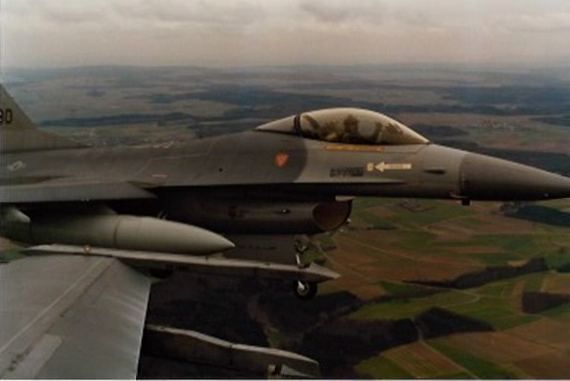
And just like that, Brahma Flight was deep in the heat of simulated combat, mixing it up with notional “bandits” enroute to the target. We were screaming across the German countryside at 500 feet above the ground (AGL) traveling at 420 knots (about 480 miles per hour). Buildings and trees rushed past the cockpit as we approached the attack “initial point” (IP). Once we crossed the simulated "border," the target area came into view. At the IP KC increased speed to 540 knots (about 620 miles per hour) for the run to the “action point” for the attack.
“Tally ho. Brahma Flight, It’s HUGE! Target is huge!”
At the action point we executed a 30-degree “pop up” from low altitude and rolled in on the target from 6,500 feet above the ground (AGL) at 450 knots, pulling 6.1 Gs as Julio lined up the attack. He called off his release and “pickled” the simulated bombs. Shack!
Brahma flight completed a “tactical egress” at low altitude and crossed back across the simulated border into “friendly territory.” The rest of the ride home felt more like a victory lap. As we cruised toward Hahn at low altitude, we flew over the Rhine River, banking for a perfect view of the Lorelei…that fabled rock along the river with more myth than stone. KC, a former USAF Thunderbird, couldn’t help himself. While Julio and I flew straight and level, KC pulled up on our left wingtip, no more than three feet away. I looked over…he waved like it was just another day at the office. Holy shit! Then, as if I wasn’t already awed, he peeled off in a slow, graceful barrel roll, and came up again…this time on our right wing. Another casual wave. I could almost see the grin under his mask.
And all I could think of, staring across at a former Thunderbird from the back seat of a supersonic fighter jet, was…
How did a kid from Port Vue end up flying low altitude over Germany in an F-16?
By the way, KC passed his initial instructor check ride.
Excerpt from Chapter 5:
“R.B. Double A Bravo” aka
Red-Blooded All-American Boy
Tactical Callsigns: The Real Names of War
One of the most sacred. . .and most humiliating. . .traditions in fighter pilot culture is the naming ceremony. Nobody picks their own call sign. It’s not a gamer tag, a pilot’s license alias, or something cool you write on a helmet. It’s earned the hard way. . .through mistake, misfortune, or something stupid you said in a mission brief.
What happened after the initial humbling was an equally funny process. The Naming Ceremony. The process is half roast, half rite of passage. Once a new pilot finishes MQT (Mission Qualification Training) and completes their first handful of operational sorties, they’re considered MR (Mission Ready). A naming ceremony is scheduled. . .usually tied to a a big deployment. The bar is stocked. The crowd is ready. And the gloves are off.
The event begins with a series of “nominations,” where squadron members share stories, each ending in a proposed call sign. These are almost always humiliating. The best ones have layers. . .referencing an incident, a personality quirk, a famous historical figure, or something deeply inside-joke level. After debate, bribery, and heckling, a vote is taken, and the new call sign is announced with a toast (and often a shot of something terrible).
Perhaps a few examples are in order (which also gives me an opportunity to re-live the inside jokes!)
Craig Wilkerson became “Skip” after strafing the skip pit on a practice target range and sending 20 mm bullets into the airspace. Strafing is a form of low-level attack where aircraft use onboard guns to fire on ground targets. On an air-to-ground gunnery range, two common target areas are strafe pits and skip pits. Strafe pits usually consist of pits filled with sand that absorb or capture the bullets. Skip pits are similar in shape, however instead of sand they are concrete, which allows a pilot’s bombs to “skip” off the concrete and onto the target. So, if a pilot strafes a skip pit, instead of the bullets getting absorbed by the sand, they skip off the concrete and become lethal to whatever is in their way. Hence, Craig Wilkerson became “Skip” Wilkerson!
John Evans became “Luigi” when he dropped a simulated training nuke and the parachute failed to deploy, sending the “slick” training bomb through the roof of a guy named Luigi who lived near Helchteren Range in Belgium. Nuclear bombs often come with retardation systems…parachutes or ballutes…to slow descent, giving the delivering aircraft time to escape the blast zone. In pilot jargon, when a nuclear weapon is delivered “slick”, it means the bomb is dropped without a parachute retardation system…in other words, free- fall. Instead of falling slowly on the target, if the parachute doesn’t open the bomb keeps flying…in this case until it hits a house. The real Luigi was watching TV in his living room when the bomb landed on the floor in front of him.
Glen Lawson became “Lunar” when, during a night intercept training mission, he decided to see if his AIM-9 Sidewinder training missile would recognize the heat signature coming off the moon. Of course, while the moon does have a heat signature… his flight lead’s exhaust was much more prominent! (To this day. Lunar swears the IR energy coming from the moon was “full and glorious” and the AIM-9 tracked the moon in “spectacular fashion”. However, let’s not allow the truth to ruin a good story!) His instructor discovered this fopah during the debriefing when they reviewed Glen’s HUD video and it was obvious Glen was trying to get a heat lock on the moon…and manuevering his jet to put the flight lead’s jet in the HUD video. (Years later Lunar flew with the Thunderbirds and Julio had the opportunity to share Glen’s call-sign story with the team, much to Lunar’s distress and the rest of the team’s delight. Lunar continues to insist his only mistake was showing the HUD video during debrief. No rebuttals!)
Once it’s assigned, that’s your identity. . .at least in the squadron, on the radio, and often for life. You can’t undo it. You just have to own it. And now, 35 years later, Skip, Deathwish, Luigi, and Lunar are still how we all endearingly refer to them!